| Written By | UltrashieldX Editorial Team |
| Reviewed By | UltrashieldX Regional Manager (18 years’ experience) |
| Last Updated | 23 November 2026 |
To understand how to remove PPF safely, start by heating the small sections with a heat gun or steamer then lift an edge with a plastic PPF removal tool and pull the film back at a low angle. Apply controlled heat so that you don’t damage the clear coat. Once the film is removed, use an adhesive remover then clean the panels.
Paint protection film removal should be done when it starts yellowing or nears its warranty period. For old, brittle films, consider professional PPF removal. PPF doesn’t damage paint when removed if you use the right techniques. PPF removal cost depends on vehicle size, film condition, coverage area, and adhesive residue. A relatively new PPF removal is generally easier than old PPF removal.
In this guide, UltrashieldX experts discuss how to remove PPF from a car or bike, PPF removal price, professional help or DIY and mistakes to avoid.
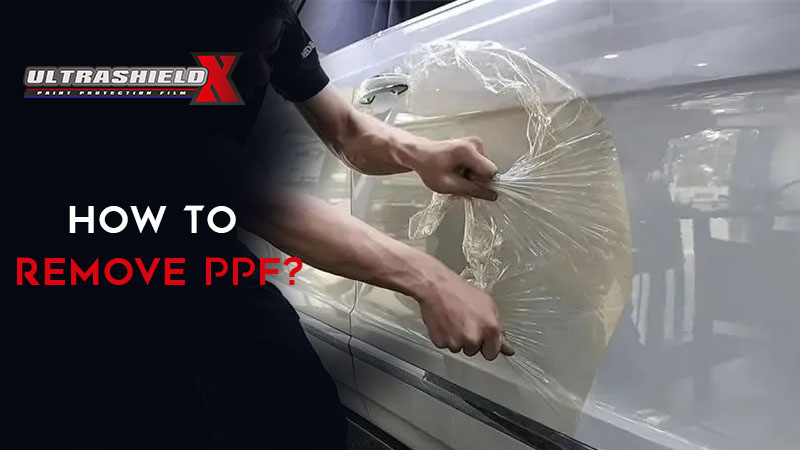
how to remove ppf
When Should You Remove Paint Protection Film?
You should consider removing paint protection film when it becomes yellow, cracked, starts peeling, brittle, cloudy, or loses its properties. High-quality PPF can last for 5 to 10 years depending on the maintenance.
Signs It’s Time for PPF Removal
- Yellowing: film turns yellow and dulls your paint’s look.
- Cracking: PPF turns brittle and breaks into small pieces.
- Peeling edges: Edges lift and trap dirt and moisture.
- Sticky residue: adhesive breaks down and leaves a messy film.
- Cloudiness or stains: Haze or permanent marks pop up on film
- Past its warranty: PPF coating has reached its lifespan and no longer protects well.
To understand more about PPF warranty, read our guide: What PPF Warranty Covers?
Expert Tip Straight From the Detailing Bay:
Naveen, a PPF expert at The Detailing Mafia with 11 years of experience in application and removal, advises not to wait until old PPF becomes completely brittle. Timely removal makes things easier and less risky. It also ensures that your paint stays safe.
Tools Required for Safe PPF Removal
Tools are needed for heating, peeling and scraping the adhesive. If you want to understand how to remove PPF professionally, here are the essential tools used by UltrashieldX experts:
Heat Gun
- Makes adhesive soft; control needed
- Film becomes easier to pull
Steam Cleaner
- Alternative to the heat gun
- Helpful on curved panels and edges
Plastic PPF Removal Tool
- Sharp metal blades can scrape the paint
- Gently lifts film edges
PPF Removal Spray / Adhesive Remover
- Makes adhesive loose and easy to lift
- Compatibility is important
Microfiber Towels
- Wipe adhesive residue
- For cleaning the surface
UltrashieldX experts also use protective gloves because some chemicals can be hard on your skin. Inspection lights are vital too because they show residues that need treatment.
How to Remove PPF from a Car: Step-by-Step Guide
Patience, controlled heat, and the correct tools are the most important techniques for PPF removal. To understand how to remove PPF, the most important thing is to soften the adhesive and maintain the correct peeling angle. Naveen explains the steps:
Step 1: Clean the Vehicle Surface
- Remove all the loose dirt from the panels and give it a good rinse.
- Dry the surface completely.
Step 2: Inspect the PPF Condition
Experts now check paint protection film for:
- Yellowing
- Cracks
- peeling edges
- brittle sections
- previous paint repairs
Step 3: Apply Controlled Heat
- Warm small sections with heat gun
- Keep your heat source moving
Expert Insight:
We asked Naveen what’s the one tip you’d swear by – Heat. It’s always hot. Warm the film with a heat gun and aim for roughly 50 to 60°C on the surface. It should be hot enough to lift the gum but cold enough so you don’t fry the clear coat. Cold PPF fights you. Pull low and slow. If it starts to resist, stop pulling and add more heat. Patience here is the whole game.
Step 4: Lift the Film Edge
- Use your fingernail or tool to lift one corner.
Step 5: Slowly Peel the PPF
- Peel the film back on itself at a sharp angle
- Almost parallel to the panel
- Do not yank it straight up toward you
- Maintain steady tension and work in manageable sections
Step 6: Remove Leftover Adhesive
- Apply a paint-compatible PPF removal spray like Ultraguard ResidueX adhesive remover
- Let the product work
- Lift the adhesive with microfibre cloth
- Never aggressively scrape
Step 7: Clean and Inspect the Paint
- Clean the panel
- Inspect it under proper lighting
Check for:
- adhesive residue
- Scratches
- Staining
- clear-coat damage
Important Precautions During PPF Removal
- Avoid excessive heat
- Your peeling angle should be low
- Do not rush the process and peeling
- Extra care for repainted panels
- Chemicals should be safe and compatible
Can PPF Removal Damage Your Car’s Paint?
Paint protection film removal can damage your car’s paint if you pick an inexperienced installer or poor-quality TPH or PVC film. If you have a high-grade PPF like UltrashieldX’s TPU-based self-healing PPF over sound factory paint, it should not damage the paint. Proper installation also matters for easy removal.
How to Remove PPF Adhesive Residue Safely
You need solvent, patience, and microfiber. Keep scraping out of the equation. A dedicated adhesive remover, Isopropyl alcohol and plastic razor blades are musts. Apply the remover to a towel.
- Lay the soaked towel over the residue
- Let it sit for 30 to 60 seconds.
- Dwell time does the heavy lifting here
- Resist the urge to scrub
- Wipe in one direction
- Circular scrubbing grinds the gunk
- Use plastic blades only for lumps
- Final wipe with IPA
- Harsh stuff like acetone or lacquer thinner can strip the clear coat
If residue still keeps coming back, you can use light polishing. Use a fine finishing polish.
DIY vs Professional PPF Removal
| Aspects | DIY | Professional |
| Cost | Low upfront | Higher, but fixed |
| Time | A weekend or more | 1 to 2 days |
| Skill needed | High. Takes practice | None from you |
| Paint risk | Real | Low |
| Repainted panels | Gamble | Tested first |
| Old, cracked film | Painful | Handled with steam |
| Cleanup and polish | Limited | Full finish |
| If something goes wrong | Your bill | Often covered |
| Best for | Small areas, fresh film | Full car, aged film |
Can You Remove PPF Yourself or Should You Hire a Professional?
You can remove new and well-maintained paint protection film yourself if you have the right tools and experience. Professionals can handle old PPF well. DIY is a fair option if it’s a small section. If it’s full-body PPF, pay the professional. Think of it as insurance against a respray bill that dwarfs the removal fee.
We asked Naveen what’s the hardest thing about PPF removal. It isn’t the heat gun. Is it the solvent? Nope. It’s the first edge. He keeps a single fingernail long just for that. Then comes the pull. Slow. Steady. Controlled. Panel after panel. Until his fingers ache. That’s not a flaw in the method. That’s the method.
What Is the Cost of PPF Removal?
Cost to remove PPF is generally not a separate package. Let us tell you our first-hand experience. In our nearly a decade of detailing experience, around 85% PPF removal requests were from customers who wanted reapplication after the old PPF was removed. So the quotation included PPF removal and new PPF application with surface prep.
Those 15% PPF removal costs were based on how old the film is, its present condition, the complexity of curves and adhesive removal.
Here is an estimate:
| Removal coverage | Approximate cost |
| Single panel (bonnet/bumper) | ₹1,500– ₹5,000 |
| Partial front | ₹5,000-₹10,000 |
| Full car (sedan/compact SUV) | ₹10,000 –₹20,000 |
| Large SUV/luxury car | ₹15,000-₹25,000 |
To budget for PPF removal, read our blog: PPF Installation Cost 2026
What increases PPF removal cost?
- Film age: Old, brittle, cracked or yellowed film is hard to remove and takes longer
- Adhesive condition: PPF adhesive removal time counts too
- Film quality: Low-quality films can tear in small pieces.
- Paint condition: Experts need extra caution for repainted panels
- Coverage area: Full-body professional PPF removal involves more labour.
What Should You Do After PPF Removal?
After removing paint protection film from car you should thoroughly clean and inspect it. It might need surface prep if you are planning for reapplication of PPF or coating. Even when you know how to remove PPF, the job isn’t complete. Not until the exposed paint has been assessed.
Does UltrashieldX PPF Damage Paint While Removing? No
UltrashieldX Paint Protection Film for car does not harm the clear coat if the application has been done with proper preparation. Moreover, it uses global-grade TPU from Lubrizol, BASF and Wanhua, combined with pressure-sensitive adhesive from Ashland.
UltrashieldX PPF’s PSA adhesive is designed to bond to a surface under applied pressure. They do not need chemical activation. This glue keeps the bonding strong while allowing controlled removal.
Experts at The Detailing Mafia are certified at three levels and are equipped with professional-grade tools and techniques for safe removal.
FAQs About How to Remove PPF
Ques. Can PPF be removed easily?
It depends on the film’s condition. If it’s a relatively new film, the removal can be quite safe and easy. But if it has passed its warranty term and turned yellow, it can be hard to remove. In this case. Always seek professional PPF removal services for safe replacement.
Ques. How much does it cost to remove PPF?
Many studios do not offer a separate PPF removal package. It is included in the PPF application instead. Confirm with your studio about the charges based on film condition, coverage and complexity of the work.
Ques. Is PPF hard to take off?
Sometimes yes. If the film has been neglected for long has has long passed its warranty term, the removal can be quite hard and risky. Because film loses its elasticity and becomes brittle. This can strip off the paint also. Best advice is to inspect your PPF before its warranty hits the end.
Ques. Can I remove PPF from my car at home?
You can but we don’t recommend it because it is a labour-intensive job and requires experience. You’ll be risking your original paint. Moreover, proper chemicals, their dilution and tools play an important role and you cannot arrange them all in your home setting.
Ques. How to remove PPF at home?
If you are attempting paint protection film removal at home, start with heat application with a hair dryer. Make sure you control it and don’t cook the paint. Or you can cover the panels with towel and then pour hot water instead. After the film becomes soft. Peel the film back on itself, low and slow. Pulling straight up stresses the paint. Pulling flat stresses the adhesive. A wide grip spreads the load. It stops the film snapping at a single spot.


0 Comments