Probably, your car is one of the most costly possessions you have. Be it a sports car that is fast and powerful, a rough-and-tough SUV, or a luxury sedan, the elements of the environment are in a constant war with your paint. The car smell is gone long before the first blemish is made on it, whether it is a stone chip or road debris, a bird dropping, or UV radiation.
Herein lies the use of PPF Coating (Paint Protection Film). It is considered to be the greatest armor in the automotive industry. Nevertheless, with the recent explosion in the popularity of Car PPF coating, there has been an equally high rate of horror stories of people who have ended up with peeling edges, yellowing film, or damaged paint.
Being long-term experts in the field of UltrashieldX, we have studied thousands of installations. Purchasing a Paint Protection Film coating is a serious investment, and just like any other investment, it must be seriously undertaken. To assist you in this process, we have made an exhaustive list of the best mistakes that you should avoid in order to keep your car safe and clean.
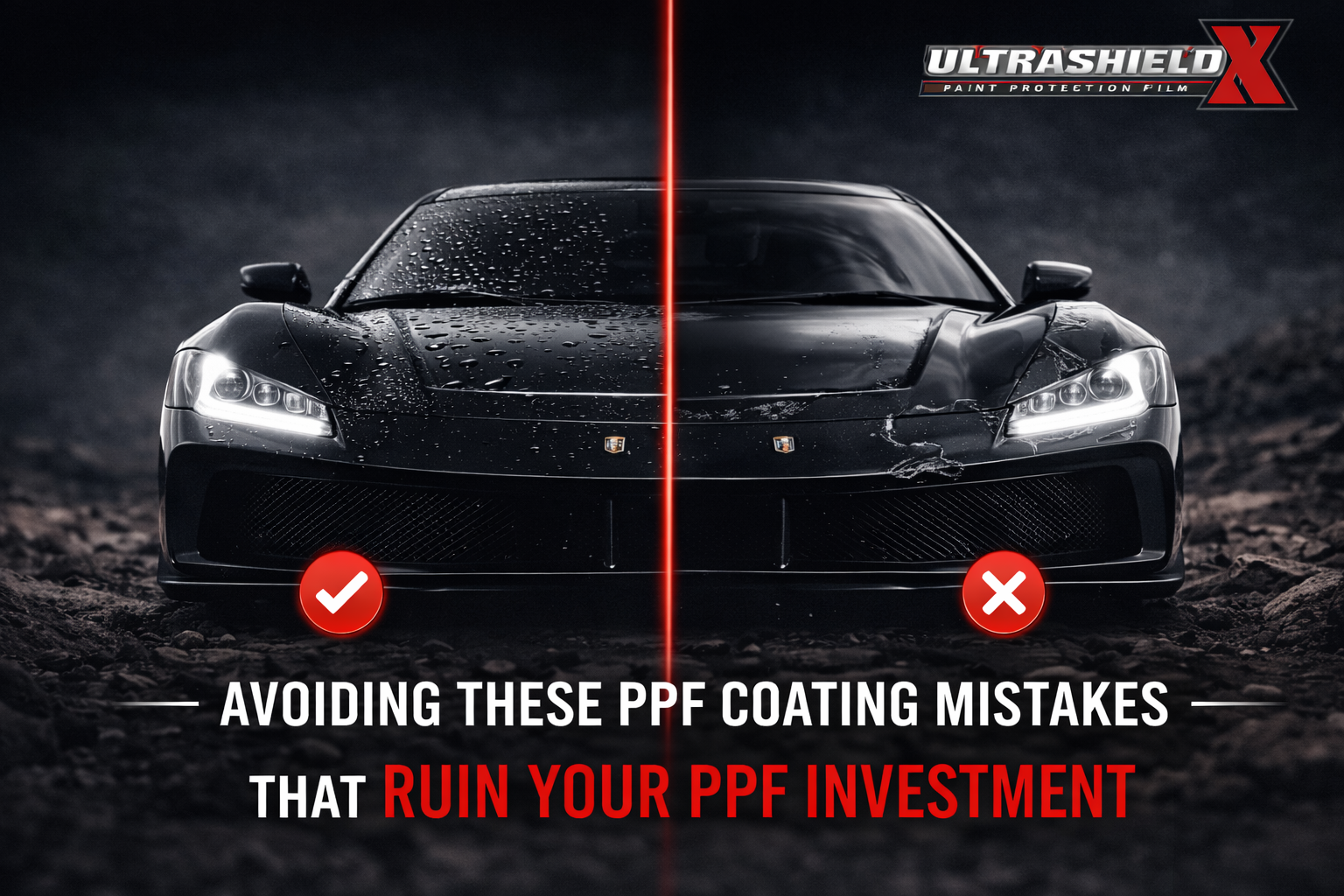
1. Is Choosing the Lowest PPF Coating Price an Issue?
The automotive detailing business is nearly a one-to-one situation when it comes to getting what you pay for. The biggest error car owners commit is to go out and buy the cheapest price of the ppf coating. Although it is a wise idea to be a budget-conscious company, cheap PPF is a costly deception.
The fallacy of low-grade materials
Films are not produced equally. The High-end Paint Protection Film is produced out of Thermoplastic Polyurethane (TPU). This is a flexible and durable material that is optically clear. The cheaper installers commonly apply PVC (Polyvinyl Chloride) or low-grade TPH films.
What will become of you when you settle on a low-priced film?
Yellowing: The PVC films do not have UV stabilizers. After 6 to 12 months of being exposed to the sun, the film starts acquiring a sickly yellow color, thus destroying the appearance of your car, particularly when it is white or silver.
Cracking and Brittleness: Low-quality films have a short shelf life of plasticizers. They are hard and can break like an eggshell, hence they are very hard to peel off without applying harsh chemicals that may end up ruining your clear coat.
Orange Peel Texture: The poor quality of the films tends to resemble an orange skin so it lessens the depth and clearness of the original paint on your car.
The dark side of inexpensive workers
Low price on PPF Coating for Car would be a good sign that the store is skimping on labour. Good installation is a time-consuming task – installation of a complete vehicle can require 3 to 5 days. When a shop claims to be able to complete a complete car in a few hours at a fraction of the market price, then they are probably not doing such important processes as edge wrapping or deep decontamination.
2. Do You Ignore the Essential Role of Surface Preparation?
Consider the use of a fingerprint and a piece of lint with a high-end smartphone screen protector over them. Now, just imagine that you did that on a very big scale on the entire hood of your car.
The PPF Coating that is applied to the Car is virtually a successful one, as determined by the events that occur prior to the film being applied to the paint.
The necessity of paint correction
Even the brand-new cars right off the showroom floor usually have swirl marks, light scratches, or transport contamination installed by the dealer. When you cover these defects with Paint Protection Film, you are basically locking them in. PPF is able to conceal very small defects; however, it is a magnifying glass for bigger scratches.
Decontamination is non-negotiable
This should be done by a professional installer who should carry out a multi-stage wash, which is followed by:
Iron Decontamination: The process involves the use of chemicals to get rid of metallic particles embedded in the brakes and rail dust.
Clay Bar Treatment: The bonded contaminants, such as tree sap and road tar, which are not completely removed during a normal wash, are removed.
Isopropyl Alcohol (IPA) Wipe: Removal of the rest of the waxes or oils to make sure that the PPF adhesive is applied to the clear coat.
Failure to follow these steps will result in either silvering (bubbles formed due to entrapment of air/dirt) or early peeling of the edges of the film.
Does your car really get security?
An incompetent PPF work is even more harmful than no protection. It can hold moisture and contaminants against your paint in the long run. In UltrashieldX, we have a stringent 10-point preparation procedure before each installation.
Ask an UltrashieldX Expert Today by calling – +91-80-100-44000.
3. What is the Reason Not to Get it Done From Unqualified/inexperienced Installers?
PPF Coating has been referred to as origami using plastic. It takes an unbelievable level of patience, hand-eye coordination, and technical expertise to perform the actions of film.
The risk of hand-cutting
Film can be fitted in two ways: Plotter-cut (Pre-cut templates) and Bulk-loading (Hand-cutting).
Hand-cutting: There are installers who like to cut a large piece of film and to cut it with a razor blade on the car. This is highly dangerous. A single slip of the hand and you have a blade cutting the film and deep into the paint of your car.
The UltrashieldX Approach: We cut the Paint Protection Film to the specific size of your vehicle panels using the highest precision, reducing the use of blades in the area of your car paint.
Unsuitable stretching and fingers
In case of overstretching of the film such that it cannot fit in a complex curve (such as a bumper), it may overstretch, causing loss of thickness and protection in that region. On the other hand, unless attached properly, there will be edges with an opening to air/water channels. These may be attempted to be concealed by an inexperienced installer by using heat, and may lead to the failure of the adhesive.
4. Are You Aware of the Distinction Between Gloss, Matte, and Color PPF?
Most of the owners enter a shop requesting PPF without knowing that there are other aesthetic options. The wrong type will give you an appearance that you did not bargain for.
Matte vs. Gloss
Gloss PPF: A transparent product. It adds volume to your factory paint
Matte/Satin PPF: This is a product that converts a shiny vehicle to a smooth matte one. In case you already have the car with matte paint that is factory applied, you will need to use Matte Paint Protection Film coating that will allow preserving the appearance. Applying gloss film on a matte car will cause the car to appear blotchy and uneven.
Color PPF
Nowadays, modern technology provides the opportunity to use the so-called “Color PPF,” which is the combination of the protective properties of TPU and the change of aesthetic of a vinyl wrap. Color PPF is, however, much thicker and more difficult to install than clear film. The most common mistake that is made by shops that are not specialized in Car PPF coating is that they think it is just like a normal vinyl, which is thinner and not as durable.
5. Do You Disregard After Care and Maintenance?
The list of the top mistakes is not over as soon as you leave the detailing studio in your car. The way you perform in the first week and the way you wash the car after that is what defines the duration of your PPF Coating.
The “curing” period
The application of PPF is done with the help of a slip solution (which is normally a combination of water and a lubricant). Microscopic traces of water are left even after the squeegee of the film is done.
The Misfit: Washing the car or leaving it in the freezing temperatures as soon as it has been picked up.
The Rule: You should not wash it first until 48 to 72 hours later, so that the film may outgas, and the adhesive may be cemented.
The effect of high-pressure washers?
The pressure washer can be used on a car with Paint Protection Film, but care should be taken.
The Error: Bending the nozzle towards the edge of a film panel. High-pressure water can grab the edge and pick up the film, or push water under it.
The Solution: The nozzle should always be kept at least 12-18 inches away from the edges and never sprayed at right angles to them.
Applying the wrong chemicals
Do not use waxes that have dyes or oil-based cleansers. These are able to weaken the top layer of the Paint Protection Film coating that is self-healing. Use neutral pH soaps and special PPF sealants.
6. Is All Self-healing Technology Equal?
The fact that a modern PPF Coating of Car heals itself is one of the “coolest” features. In case of improper washing, the top coat can be reset by the heat of the sun or warm water, and the scratches would vanish.
The Fallacy: There are no films that do not have this
The films on the older generation and the films on the budget TPH films lack a genuine automotive top coat. These films get scratches on the paint, and within a year, they will appear flat and foggy. When offering a price for a PPF coating, there is always a need to make sure that it is a film with a self-healing top coating that holds heat-activated elements.
7. Have you Forgotten to Check on the Warranty?
A strong brand of Paint Protection Film supports its product.
Problem: Accepting an oral warranty on the part of an installer.
The Standard: The warranty (5, 7, or 10 years) provided by such high-quality brands like UltrashieldX is guaranteed by the manufacturer and includes yellowing, bubbles, and cracking.
A physical or electronic warranty card would always be best to request. When a store cannot supply one, then it is an indication that they are supplying white-label or unbranded film that does not guarantee any quality in the long run.
8. The Reason Why a Partial Front Protection is a Mistake
A common way of saving money is to install a “Partial Front” kit (only the front half of the hood is covered).
The Problem: With time, a visible line will form in the middle of your hood at the end of the film. Dust gathers at this border, thus rendering it unattractive. Besides, the half of the hood that is not covered will continue to be hit by stone chips and UV fading.
The Better Move: In case of budget considerations, it is not uncommon to cover the Full Front (Full hood, full fenders, bumper, and mirrors) as opposed to a partial. This guarantees that there are no visible lines or covering of the most vulnerable areas.
9. Is Your Store Environmentally Controlled?
The environment is everything in the case of PPF Coating, as you might assume that a garage is a garage.
Caution: The installation of PPF in an open-air bay or a dusty workshop.
The Effect: The dust particles are suspended in the air. When they touch the adhesive side of the film in the process of installing, they remain permanently as minute bubbles or zits.
The Professional Standard: Find a studio that is enclosed and well-lit, and preferably one with an air filtration system. This is what distinguishes a good job and a concourse-level finish.
10. Not Establishing Realistic Expectations
And the last thing is the greatest mistake, which is the belief that PPF will make your car invincible.
PPF is not armor plating: It is capable of stopping stone chips, but it may not stop a big, sharp rock at 100 mph.
PPF does not solve the problem of cleanliness on a long-lasting basis: You still have to wash your car. Actually, bird droppings, bug splatter, etc., can wash off the PPF within the shortest time possible, because the acids may ultimately cut the film when left in the scorching sun over a couple of weeks.
The UltrashieldX Checklist to Success
To make sure that you are not a victim of these pitfalls, use this checklist before signing a contract with Paint Protection Film coating:
| Feature | What to Look For | Why It Matters |
| Material | TPU (Thermoplastic Polyurethane) | Prevents yellowing and allows self-healing. |
| Installation | Pre-cut Plotter Templates | Prevents razor cuts on your car’s paint. |
| Prep Work | Full Decontamination & Paint Correction | Ensures the film looks invisible and stays bonded. |
| Warranty | 5-10 Year Manufacturer Warranty | Protects your investment against product failure. |
| Environment | Clean, Dust-Free, Indoor Studio | Prevents unsightly dirt bubbles under the film. |
Conclusion
PPF Coating is the best thing you can do for your vehicle to ensure that it lasts longer. It not only keeps the paint in the factory finish condition but also makes it easier to clean and increases the resale value by a huge margin. It may, however, be a nightmare when the price of the PPF coating is cut, the wrong installer is selected, or the aftercare is not taken into consideration.
In UltrashieldX, we boast not only of being installers but also of being fans, and we consider every car ours. Our Paint Protection Film is the highest grade available, our technology is precise, and our installation process is industry-leading, so we can guarantee you a car that looks like it was brand new even after several years.
It is time to provide your car with the security it requires.
Waiting till you get the first stone chip to spoil your day. Call the specialists at UltrashieldX at +91-80-100-44000 to find out why we are the ones to rely on for high-quality car PPF coating.
FAQs on PPF Coating Mistakes
Q1. Does the lowest price of PPF coating necessarily indicate bad things?
A1. Yes, usually. Very low prices, PPF can be used as a sign of using PVC, rather than high-quality TPU. The low-cost films do not have the ability to heal themselves, turn yellow fast, and may destroy your paint when it is removed.
Q2. Would it be possible to avoid paint correction before the installation of Paint Protection Film?
A2. No. The use of PPF Coating without paint correction locks out swirling or scratching on cars. To achieve a perfect finish, which is invisible, the surface has to be decontaminated and polished in a professional manner.
Q3. Does a Car PPF coating ensure that my car is 100 percent scratch-proof?
Although Paint Protection Film is very tough and it also has the capability of self-healing the swirl marks and minor abrasions, it is not invincible. It is also meant to absorb the force of the stone chips and road debris, which would otherwise cut your paint.
Q4. What is the duration of time that I should wait before washing my car after coating it with PPF?
At least 48 to 72 hours should be waited. The glue requires time to dry, and the rest of the water that might have been used in the process of installing the glue should evaporate. Premature use of a pressure washer may result in lifting of the edges.
Q5. Does PPF coating need special maintenance?
The majority of the time, no; however, you should not use petroleum cleaners and abrasive waxes. Use soaps that are neutral to pH, and avoid the high-pressure streams of water, which should not be used to ensure that the film lasts.
Q6. Do you believe that hand-cut PPF and pre-cut PPF are different?
Yes. Software-designed templates (as used by professionals such as UltrashieldX) are developed to fit your car perfectly. Hand-cutting is done by a razor blade on the car surface, and this has a high chance of accidental paint cuts.
0 Comments