The Indian auto sector is on the rise. According to the Society of Indian Automobile Manufacturers (SIAM), India has, for the first time in 2024-2025, passed the magic number of 4.2 million passenger vehicles in sales. Cars are the second-biggest investment for an Indian family, and are also status symbols.
So, the first instinct of a new car owner, after bringing home a new car from the dealership, is to preserve the look of the car. So you can get it done with UltrashieldX Paint Protection Film. Because all experienced drivers in Delhi, Mumbai, or Bangalore know, the “new car smell” and shine of a car’s paint job are only temporary. Within a few weeks, the traffic, dust, and sun take a toll.
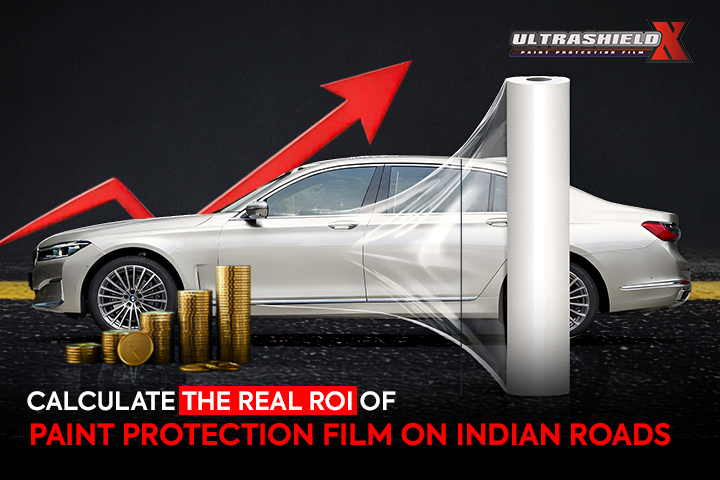
Do you need Paint Protection Film (PPF)?
For your Lamborghini or Ferrari, or even a family car like a hatchback, sedan, or SUV? In this comprehensive blog, we will explore the “value” of Paint Protection Film for the Indian daily driver.
What is the “Problem” With Indian Roads?
To understand the rise of the multi-billion-dollar Paint Protection Film industry in India, it is important first to examine the “Perfect Storm” of factors scientifically designed to wreak havoc on car clear coats in the subcontinent.
1. The Issues of “Road Rash
India has the world’s second-biggest road network. But with such road-building mega-projects as the Bharatmala Pariyojana, a few thousand kilometres of roads are being constructed. So the stones are left to be flicked up by the front wheels of the car in front.
The stone striking the bumper at 80 km/h is like a bullet. This creates “road rash” or small nicks and chips down to the primer or even bare metal. And this can damage the bare metal in a few days, particularly in tropical coastal regions such as Chennai or Kolkata.
2. Bumper-to-Bumper Traffic
India is not known for its “personal space”. There are more than 4.2 million registered two-wheelers, as stated in Statista data records, and traffic is intensely heavy. Riders and pedestrians often find themselves navigating through tight spaces.
There’s bound to be some “rub-off”. Even the handlebars of a scooter or the zipper of a backpack can damage your door. Unless protected, these scratches and bumps, and dings and dents, turn your new car into an old one.
3. Environmental Aggression
The Indian climate is very challenging for car finishes.
UV Radiation: Most Indian cities have a high UV Index and IR rays daily. According to World Weather Online, this radiation destroys the bonding of the clear coat and produces “chalking” and fades the paint.
Hard Water & Dust: Car cleaning in India is generally done by “society cleaners” with a single bucket of hard water and a filthy cloth. This is what causes “swirl marks & tiny scratches that dull the paint’s appearance.
Biological Hazards: The acidity of bird poo and tree sap can damage a car’s paint in under 48 hours in the Indian sun.
How Paint Protection Film for Car Works
Paint Protection Film is not a “sticker” or “wrap”. It is a very high-tech, multilayered Thermoplastic Polyurethane (TPU) film.
The Science of TPU
The Best Paint Protection Film makers choose TPU for their film because it’s an elastomer. TPU is a stretchy material and stretches up to 150% before breaking. If a stone hits a PPF car, the PPF will absorb the impact. It will deform and then snap back into shape, saving the paint.
The “Self-Healing” Miracle
The biggest innovation in the world of Paint Protection Film is the Self-Healing Top Coat. The top coat is made of a dense “memory” polymer. When this layer is damaged (by cleaning it or by a bush), the molecules are displaced. Heating it, either by exposure to the sun or by putting hot air with the help of a hot air gun, causes the polymer to “flow” back into its flat shape.
Insight: In a country like India, where the temperature often rises to 40°C and beyond, a paint protection film for car “repairs itself of any swirl marks every time it is left outdoors.
Paint Protection Film vs. Ceramic Coating: Which One is Better?
It’s the biggest question in detailing studios in India. Let’s compare the two technologies on the factors that are important to Indian car owners.
| Feature | Ceramic Coating | Paint Protection Film (PPF) |
| Physical Protection | Minimal (Does not stop stone chips) | Superior (Stops chips and scratches) |
| Self-Healing | No | Yes |
| Chemical Resistance | Excellent (Bird droppings/Acid rain) | Excellent |
| Maintenance | Requires specific shampoos/boosters | Easier (Self-heals the swirl marks & scratches) |
| Longevity | 1–7 Years | 3–10 Years |
| Investment | ₹15,000 – ₹45,000 | ₹75,000 – ₹2,80,000 |
Ceramic Coating is a chemical barrier and provides a good shine and easy washability. PPF is a physical barrier. If you have a car that you drive every day in India, Ceramic Coating is like having a raincoat, and Paint Protection Film is like having armour. You can enjoy the advantages of both by getting ceramic coating done on top of your vehicle’s PPF.
Why Brand Quality is important (The TPH vs. TPU scam)
There are “Paint Protection Film” packages in India from as low as ₹40,000 to as high as ₹3,00,000. This is because of the materials used.
1. Beware of TPH (Thermal Plastic Hybrid)
TPH is commonly used in low-budget detailing shops. This is a PVC (vinyl) film with a coat.
Yellowing: PVC reacts to UV light. In India, TPH films will get yellow in 6-12 months.
Adhesive Damage: Cheap films use aggressive adhesives. When it’s time to take the film off, it can actually come off with the car’s paint.
No Self-Healing Properties: TPH lacks TPU’s elastomeric properties.
2. UltrashieldX TPU is Better
Best PPF Brand in India, such as UltrashieldX PPF, contains high-quality TPU with UV stabilisers. These films are optically clear, rather than “orange peel” like cheaper films. And they have low-tack adhesives, so the film can be removed without damage even after 7 years.
Is PPF saving up your money?
The initial price may be high, but Paint Protection Film is generally a profitable investment if you consider the 5-year (average) ownership of a car.
1. Resale Value Retention
“Original Paint” is highly sought after in the Indian used car market. As per reports from websites such as Cars24 and OLX Auto, the resale price of a car with original paint can be 10% to 15% more than a repainted car. The cost of repainting a panel at an authorized service centre ranges from ₹6,000 to ₹15,000, and it is also considered “accident history” by insurance. Whereas a ppf film for car can keep it in “showroom condition” for the new owner.
2. No More Paint Correction
For a car that is driven every day, without Paint Protection Film, it is generally recommended to get a rub/polish every 6-12 months to eliminate oxidation and swirls. Whenever you polish a car, you are “taking off” a few microns of your clear coat.
Polishing cost: ₹4,000 – ₹8,000 per session.
PPF cost: No need to polish the PPF.
3. Scratches and Parking Lot Damage
Small scratch keys (a typical form of parking vandalism) are bad. With PPF, it remains on the film. Most often, the heat will repair it. In extreme cases, you can replace the film on just one panel, much less expensive than factory colours.
Types of PPF Film for Car Finishes
You can protect your car and improve its appearance.
Gloss PPF: It is the most common. It is almost invisible and creates a “wet look” effect.
Matte/Satin PPF: This will turn any shiny car into a satin-finished machine. It’s a good option to achieve “Mercedes or BMW in matte look” and the best way to preserve the original paint.
Black PPF: Black PPF (TPU) wraps do not have the same reflective qualities as other vinyl wraps. It is often used for “two-tone” roofs or to “mask” chrome.
The Importance of Professional Installation
Car paint protection Film is highly dependent on the installer. An improper installation can result in:
Lifted Edges: Dust getting trapped under the film.
Blade Marks: DIY installers cut the film on the car’s paint.
Stretch Marks: Film being over-stretched, causing the TPU to be damaged.
UltrashieldX uses Pre-Cut Templates. We use a computerised cutter to cut the film precisely to the size of your vehicle make and model. This eliminates the risk of damaging your car paint, and the edges are tucked to give you an invisible finish.
Aftercare of Car Paint Protection Film
PPF is extremely durable, but not completely bulletproof. To get the most out of your paint protection film, do the following:
Wait 48 hours: Wait at least 48 hours before washing the car so that the glue dries.
Pressure Washing: Inform the car washer to keep the pressure washer 12 inches away from the film.
Bird Droppings: Although PPF is acid-resistant, it’s recommended to clean up acidic bird droppings within 24 hours to avoid “clouding”.
Waxing: PPF doesn’t need to be waxed, but if you want to improve the water-beading (hydrophobic) effect, then apply a ceramic sealant.
Why Should I Get it Done?
If you are someone who:
- Intends to use your vehicle for at least 3-5 years.
- Commutes regularly in traffic or on the freeway.
- Appreciates the look of a “new car”.
- Has a keen eye for resale.
Then it’s well worth it to invest in Paint Protection Film. It is the only product that takes into account the conditions of Indian roads.
Don’t wait until the first rock chip damages your hood. We are the premier PPF provider of advanced technologies, with India’s only nationwide-certified detailing specialists.
Don’t wait, just protect your investment with UltrashieldX –+91-80-100-44000.
FAQs on ROI of PPF
Q1. Why Paint Protection Film essential for India?
The high UV, debris, and lack of space on Indian roads result in “road rash” and scratches that can’t be prevented through ceramic coatings. PPF is the line of defence against these.
Q2. How much does a Paint Protection Film cost?
Quality TPU film ranges from ₹75,000 to ₹2,80,000. Inexpensive films (below ₹40k) are low quality, yellow, and ruin the car’s original paint.
Q3. Does PPF give out good resale value?
Yes. 10-15% more resale value for “Original Paint” vehicles. PPF stops repainting, which buyers suspect to be accident damage.
Q4. Paint Protection Film or Ceramic?
Ceramic coating shines and make easy to clean your vehicle; PPF armor protects. PPF is best for everyday use. You can even give your car the benefit of both services.
Q5. Does Paint Protection Film really Self-heal?
Yes. The sun heats the film, and swirls/light scratches disappear.
Q6. What is the life span?
High-quality TPU films will last 5-10 years. They are designed to be non-yellowing and cracking-resistant in tropical conditions.
0 Comments