Paint Protection Film is a self-healing, TPU (Thermoplastic Polyurethane) film that acts as a sacrificial layer and is applied to your car’s OEM paint. PPF protection against rock chips, scratches, and minor abrasions. Ceramic Coating is a liquid polymer that chemically bonds with your car and forms a hard but thin layer on the panel. The coat makes the paint highly glossy, hydrophobic, and easy to clean.
Nowadays, modern cars have thinner paint (90 to 100 microns). The clear coats aren’t as durable as they used to be. It’s prone to swirls, hard water spots, bird droppings, and stone chips. The phenomenon makes car paint protection a necessity. Two popular options are ceramic coating and car paint protection film.
We have curated a detailed comparison with our experts and will discuss protection, durability, maintenance, cost, and when to choose each.
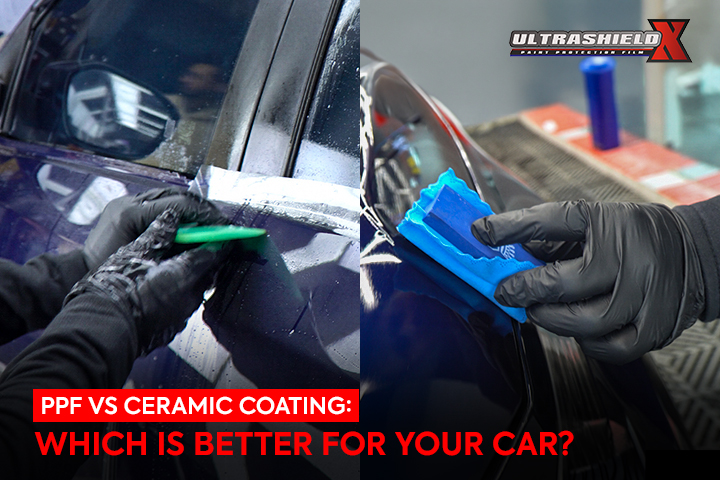
PPF vs Ceramic Coating: Quick Comparison
Ceramic coating vs PPF are the two main means of factory paint protection. However, the difference exists in the deliverables:
| Feature | Paint Protection Film | Ceramic Coating |
| Protection level | High, from scratches and chips | Comparatively low, doesn’t protection from scratches |
| Scratch resistance | Yes, minor scratches | No |
| Stone chip protection | Yes | No |
| Thickness | 190-200 microns | 1-3 microns |
| Gloss | Yes, comparatively low than coating | High gloss |
| Self-healing | Yes | No |
| Hydrophobic properties | Yes, modern PPF comes with ceramic-infused top coats | Yes |
| UV protection | Yes | High |
| Lifespan | 7-10 years | 1-7 years |
| Maintenance | Precautions are important requires care | Upkeep becomes easy |
| Cost | High (starting from Rs 80,000) | Comparatively low from PPF (starts from Rs 10,000) |
| Best for | Physical protection | Protection from chemical contaminants and shine |
What is Paint Protection Film (PPF)?
Paint protection film is a thermoplastic urethane film applied to the painted surfaces of a vehicle. It is clear, durable, and self-healing. It is a shock-absorbing layer that protects the paint from daily wear and tear. Based on multi-layer construction technology, car PPF coating comprises three layers:
TPU Construction
TPU is an advanced plastic. It features elasticity, chemical resistance and optical clarity. The old generations of clear bras (PPF) were made from PVC (Polyvinyl Chloride) but they had their limitations. Then the industry shifted to TPU PPF film which was highly flexible yet hard.
Adhesive Layer
This glue is specially formulated to stick to your car’s clear coat. It is designed to be removable without leaving any residue.
Self-healing Top Coat
The self-healing PPF has a top coat with shape memory. When any scratch occurs, the molecules shift. When heat is applied, the molecules return to their original shape. It makes the scratches disappear. Apart from this, it also protects from environmental contaminants:
- bird droppings
- acid rain
- harsh chemicals
Types of PPF
PPF film is categorised based on two criteria:
- Raw material used: TPU PPF, TPH PPF, PVC PPF
- Visual finish: Clear PPF, coloured PPF, black paint protection film
How Paint Protection Film Works
Our PPF applicator, Navin, explains,
PPF film for a car acts as an ablative coating that takes damage on itself before it reaches the clear coat of the paint. Instead of damaging the factory finish, the hazards face the film first. With its functional top coat, car paint protection film heals and protects from bug splatter, tree sap, UV rays, and oxidation.
Benefits of Paint Protection Film
With its advanced surface chemistry, PPF delivers exterior protection. Without trading off the original finish.
| Benefit | Best Paint Protection Film Advantages |
| Stone-chip protection | TPU thickness: 6-12+ mil |
| Scratch reduction | Self-healing elastomeric topcoat |
| UV resistance | UV-stabilized TPU with inhibitors |
| Chemical resistance | Resistant topcoat and stable adhesive system |
| Optical clarity | Low haze, high transparency |
| Hydrophobic performance | Low-surface-energy topcoat |
| Paint preservation | Physical barrier against contamination |
| Resale value protection | 15% higher |
Limitations of Paint Protection Film
- Paint protection film is expensive.
- The film can stain from acidic contaminants and turn yellow under high UV radiation.
- Poorly tucked-in edges can lift at high speed.
- Dents, deep scratches, or major impacts cannot be averted.
- Skilled installation is 50% important.
- Maintenance matters to keep the performance at its maximum.
An Expert Tip:
Many PPF cons don’t really belong to the film itself but to the installation. Even the best paint protection film can fail the paint if the installation is poor. Improper PPF application can lead to:
- Bubbles
- Lifting edges
- Visible seams
- Contamination trapped beneath the film
- Premature peeling
What is Ceramic Coating?
Nano ceramic coating is a semi-permanent layer of paint protection. Imagine a human skin. We have multiple pores. The same goes with OEM paint. At the microscopic level, your paint’s clear coat has multiple pores. Ceramic coating, made with Silicon Dioxide, fills those pores once applied. When it cures, it forms a sleek yet hard barrier. This barrier enhances gloss, repels water and dirt.
Chemical Bonding
Ceramic coatings form a permanent chemical connection with your car’s paint. At the molecular level, ceramic coating for car shares electrons with the clear coat. This bond is called a covalent bond. This hard bond cannot be washed off with water and soap. The only way to remove it is through heavy friction.
Hydrophobic Effect
Once the coating bonds with the paint, its chemical structure makes the surface low-energy. What does it mean? Water, mud, oil, and bird droppings cannot find a chemical foothold. They don’t stick and get washed off.
UV Resistance
Bare factory paint gets bombarded with UV radiation. These can break the chemical bond in the paint. The paint becomes dull, chalky and eventually loses its luster. Ceramic coat is made of Silicon and Oxygen (Si-O) which is extremely strong and cannot be snapped off. The bond is highly heat-resistant. It also resists UV with:
- Physical deflection and scattering
- Active UV observers combined in the coating
How Ceramic Coating Works
Ceramic coating works by turning liquid polymers into a hardened shield. This is ultra-smooth and locks into your OEM paint. Nano ceramic coating gives a slip and slide effect which makes the vehicle easy to clean.
Benefits of Ceramic Coating
Here is the detailed breakdown of the benefits of ceramic coating:
| Benefit | Ceramic |
| Super Hydrophobic | Contact angle: 100°-115°, which repels water, dirt, and grime |
| Extreme Hardness | 9H Pencil Hardness that reduces swirls |
| UV Protection | UV-A and UV-B Blocking (Si-O Bonds) |
| Chemical Resistance | Protects against bird droppings, bug splatter with pH resistance: 2-12 |
| Mirror-Like Gloss | Enhances paint depth and delivers a high-gloss finish |
| Long-Lasting Durability | 2-5 years lifespan |
| Ultra-Thin Protection | 1–3 microns |
Limitations of Ceramic Coating
- Nano ceramic coating doesn’t stop rock chips or deep scratches.
- It can still get water spots if not maintained.
- Ceramic coats for cars can sometimes show swirls and defects.
- DIY ceramic coating applications can leave streaks.
PPF vs Ceramic Coating: What’s the Difference?
Let’s dive into a deeper comparison between PPF vs ceramic coating:
Protection Against Rock Chips
PPF Coating: disperses the force of flying debris before it reaches the paint. It protects from rock chips.
Ceramic Coating: designed to be very thin for surface and chemical protection but not from chips.
Winner: Paint protection film
Scratch Resistance
PPF: Features a self-healing top coat that heals when contacted with heat (up to around 10-20 microns deep).
Ceramic Coating: It’s a rigid layer. It has no elastic or self-healing polymers. Once a scratch happens, it becomes permanent.
Winner: Car PPF coating. However, both can hide minor swirl marks.
UV and Oxidation Protection
PPF: It blocks harmful UV rays. Stop oxidation and fading.
Ceramic Coating: It comes with UV absorbers that deflect the radiation.
Winner: Both, as they provide UV protection, although via different technologies.
Gloss and Appearance
PPF: Paint protection film preserves the factory paint finish. It can add a gloss or matt appearance depending on the film finish.
Ceramic Coating: Gives color depth, clarity, and gloss.
Winner: Ceramic Coating
Water Repellency
PPF: Hydrophobic qualities are lower than ceramic coats. It is designed for shock absorption. The contact angle is low (90°-100°).
Ceramic Coating: The surface becomes hydrophobic. The low-energy surface prevents contaminants from sitting on the surface.
Winner: Ceramic coating for car
Durability and Lifespan
PPF: Lasts 7-10 years with proper maintenance. But the period depends on film quality.
Ceramic Coating: Lasts 2-5 years, depending on the coating quality. Can require a top-up coat after 1-2 years.
Winner: Car Paint Protection Film
Maintenance Requirements
PPF: You need to do regular washing and occasional decontamination. Contaminants can etch into the top coat if left.
Ceramic Coating: Regular cleaning is important. But it becomes easier because of the hydrophobic surface.
Winner: Ceramic coating
Installation Process
PPF: Prep work is almost the same. But precise cutting, stretching, and alignment are needed. Professional installation is a must. Downtime is more than ceramic coating.
Ceramic Coating: Quicker and less complex than PPF installation. DIY is also popular.
Winner: Ceramic Coating
Warranty
PPF: paint protection film for cars is backed by a manufacturer’s warranty. From 5 to 10 years. It can be claimed if yellowing, cracking, peeling, and delamination occur.
Ceramic Coating: Coating performance has a 2-5 year warranty.
Winner: PPF
Overall Cost
PPF: Premium pricing. Because of the film quality and labor-intensive installation. But the cost is justified by paint protection.
Ceramic Coating: Installation costs are lower if you compare PPF vs ceramic coating cost.
Winner: No clear winners. Depends on your priorities.
PPF vs Ceramic Coating Cost
Let’s look at the money factor:
| Coverage Type | PPF Price in India | Ceramic Coating Price in India |
| Entry-Level | ₹25,000-₹70,000 | ₹15,000-₹25,000 |
| Mid-Range | ₹1,50,000-₹4,00,000 | ₹25,000-₹45,000 |
| Premium | ₹2,00,000-₹3,00,000 | ₹45,000-₹75,000 |
What PPF and Ceramic Coating Can’t Protect Against
We have already covered PPF vs ceramic coating pros and cons. But you must know that both aren’t invincible.
- Major dents and wrecks
- Large flying rocks
- Bad car washes
- Sun-baked water spots
- Extreme dirt buildup
Which is Better: PPF or Ceramic Coating?
PPF or ceramic coating both have different outcomes despite a few similarities. What you choose depends on your priority, driving conditions, and car’s value. For example, entry-level cars have the thinnest paint which means they need more protection. But using a full-body PPF doesn’t make financial sense for Maruti Suzuki WagonR, Swift, Baleno, Tiago, or Grand i10. Because it costs 20-50% of the vehicle’s value. These car owners can choose a ceramic coating with 3 to 5 years of warranty.
On the other hand, you might think, why would a Land Rover Defender owner choose ceramic but not PPF. A luxury-car owner can still choose ceramic over PPF based on risk exposure. And even a fleet vehicle can go for a full-body PPF because it faces most of the daily damage.
It all boils down to choose between PPF and ceramic coating based on your vehicle’s risk exposure. If you drive only on weekends and use the metro for your daily commute, ceramic coating works fine. But if you commute daily from your car via expressways or congested roads, PPF is your go-to choice.
Choose Paint Protection Film if…
- You do highway driving almost daily
- You own luxury cars or even mid-ranged one
- Dark-colored cars because they show scratches easily
- New vehicles to protect that original shine
- If you plan on long ownership of your vehicle
Choose Ceramic Coating if…
- You don’t drive on busy routes. Mostly city driving
- You are constrained by budget
- You don’t want hectic schedules for car wash every now and then.
- You want gloss
What Our Experts Suggest: The Hybrid Option
Being a premium detailing studio, The Detailing Mafia recommends installing UltrashieldX paint protection film on high-impact areas first. Then apply ceramic coating over the exposed paint. With combined application, the benefits will be combined too.
What we recommend to our customers: The “Track Pack” Hybrid Setup
| Protection Zone | What It Covers |
| PPF on the Front (The Armor) | Front bumper, hood, fenders, side mirrors, headlights |
| Ceramic Coating Everywhere Else (The Shield) | Doors, roof, trunk, rear bumper |
| Ceramic Coating Over the PPF (The Top Layer) | The entire front area where PPF was placed |
Should You Apply PPF or Ceramic Coating First?
PPF should be applied first. Then you finish with the ceramic coating. This is the only right order if you are choosing a hybrid option. If you apply a ceramic coat first, then it will create the slide-off effect. The adhesion of PPf won’t work on ceramic-treated panels. This order also makes sense because PPF is for physical protection and ceramic coating enhances gloss and shine.
PPF vs Ceramic Coating vs Graphene Coating
Graphene coating is a kind of ceramic coating paint protection with improved outcomes.
| Feature | PPF | Ceramic Coating | Graphene Coating |
| Main Protection | Stone chips, scratches, and physical impacts | UV rays, chemicals, and contaminants | Similar to ceramic with improved resistance |
| Paint Chip Protection | Excellent | Minimal | Minimal |
| Scratch Resistance | High | Low | Low |
| Durability | 7-10 years | 2-5 years | 3-7 years |
| Price | ₹50,000-₹2,00,000 | ₹15,000-₹45,000 | ₹35,000-₹50,000 |
PPF vs Ceramic Coating for Bikes
PPF vs ceramic coating for bikes is also a popular option. Bikes face unique challenges. Your knees rub against the fuel tank. Keys scratch the ignition area. Loose gravel is kicked directly on the engine bay and fenders.
PPF vs Ceramic Coating on Bike: What Suits Where
| Bike Part | Best Protection | Why? |
| Fuel Tank | PPF | Prevents scratches from zippers, keys, and knees |
| Engine & Exhaust | Ceramic Coating | It handles high temperatures and protects metal parts |
| Swingarm and Rear Wheel | Ceramic Coating | Keeps chain grease and mud from sticking |
| Front Fairing | PPF | PPPF here can protect against stone chips and road debris |
| Headlight | PPF | Chips, scratches, and yellowing prevention |
Why Choose UltrashieldX Paint Protection Film for Car
Backed by the 39-year heritage of Manmachine Group, UltrashieldX is exclusively offered by The Detailing Mafia. It has 255 studios across India that offer high-quality PPF film for car and ceramic coatings.
- Our TPU is sourced from market leaders such as Lubrizol and BASF.
- We have experienced staff, certified by the three-level training, who do excellent surface prep for the best outcome.
- Our ceramic coating range is taken from Labocosmetica’s professional coating range. From HPC to Blindo, you get options as per your preference.
- The warranties on both range from 3 years to 7 years. Ceramic coating warranties start from 1 year while PPF warranties go up to 10 years.
- Our diverse range of paint protection film features coloured PPF with 200 micron thickness.
Conclusion
There isn’t a universal winner when it comes to PPF vs ceramic coating. PPF film for car is ideal for maximum physical protection. Ceramic coating has excellent UV resistance and gives a premium shine. Like showroom gloss. But the important thing is to choose an experienced installer. Choose between PPF and ceramic coating based on costs, film quality, and results. For the most comprehensive protection, choose UltrashieldX paint protection film.
Find your nearest UltrashieldX PPF coating today.
Call us at: +91-70-420-40461
FAQ’s on PPF vs Ceramic Coating
Q.1 Which is better, PPF or ceramic coating?
Both are good for different problems. PPF excels if you want protection from chips and scratches. Ceramic coating is better for maintenance. Combine both for maximum safety.
Q.2 Can ceramic coating be applied over PPF?
Yes. You can apply ceramic coating over PPF for hydrophobic properties.
Q.3 What are the disadvantages of PPF coating?
PPF coating disadvantage is that it is pricey for a number of car owners. The installation cost is higher and the downtime is around 4-5 days.
Q.4 Is PPF worth it compared to ceramic coating?
Yes. PPF is worth it compared to ceramic coating if your goal is to stop chips. Ceramic coating is best for chemical resistance and keeps your car dust-free. It cannot protect from scratches.
Q.5 What destroys ceramic coating?
Ceramic coating is killed by heavy friction. Harsh chemicals and neglect can also wear it down. Regular maintenance is needed for extended life.
Q.6 Which option provides better long-term value?
PPF generally provides better long-term value because it prevents damage to OEM paint and is durable in the long run.
0 Comments