Indian summer does not only mean a time of year, but it’s also a challenge to drivers as well as vehicles. As the ambient temperature in cities like Ahmedabad, Delhi, and Chennai keeps going up and exceeding the 45°C mark, the car parked in the sun can quickly turn into a thermal hotspot. Research projects have been conducted to determine how warm the interior of a car gets during the Greenhouse Effect Concentration process when its temperature is 20°C higher than the outside temperature in only 10 minutes.
In today’s modern lifestyle, an owner of an Indian car cannot imagine a window tint that is not a necessity; rather, it is a must-have for the health and safety of the driver and the longevity of the car. Here we’ll delve into window tint film molecular science, the mores of Indian road law, and much more.
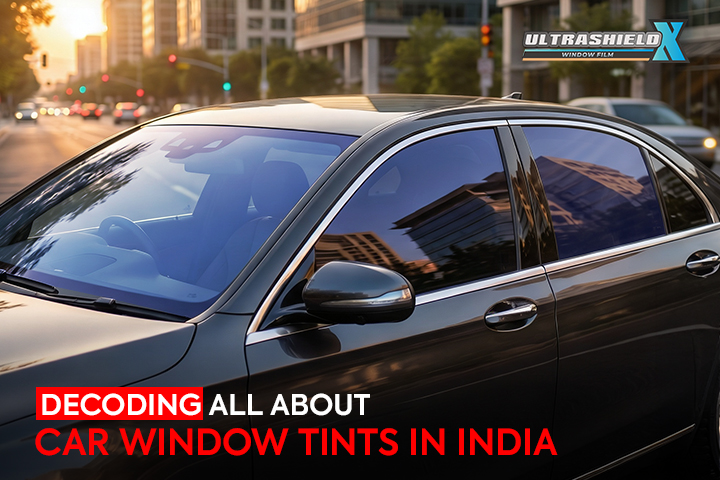
Is Window Tinting Legal in India?
Yes, window tinting in India is legal. Window Tinting in India is legal. Section 100 of the CMV Act is known as the ‘Rule 100’.
For any car enthusiasts in India, the biggest challenge is the legal aspect. In 2012, the Supreme Court of India gave a historic verdict on banning black films on car windows. But many believe that any window treatments are prohibited.
The law that is relevant to Visual Light Transmission (VLT) is the Central Motor Vehicles Rules (CMVR), 1989.
The Legal Breakdown:
- Must be a minimum of 70% VLT on Front and Rear Windshields.
- Side Windows: VLT should be 50% or greater.
The “ban” mainly targeted dark, non-transparent films, which made it difficult for the police to see inside the car and ensure safety. Today, the window tinting services are available in the new “Clear Films” or “Solar Control Films. These are high-tech, virtually invisible layers that keep the legal VLT whilst blocking two heat spectra: Infrared (IR) and Ultraviolet (UV).
Why Compliance Matters?
The traffic cops in Tier-1 cities have started the process of testing for transparency with the introduction of digital Lux meters this year. Fines may be anywhere from ₹500 to ₹2000, and if repeated offenses of the rules are made, the registration may be suspended. Compliance testing is carried out before installation at UltrashieldX so that our best car window tint solutions are guaranteed to be compliant.
What’s the Difference Between the Window Tints for Cars?
The best way to persuade people to see the differentiation in window tinting is to have better knowledge of window tint science. Not every film functions in the same manner.
1. Nano-Ceramic Window Tint
The most durable window tint films available, Nano-Ceramic Window Tint is the premium choice. Nano ceramic films are the newest and most advanced solar control films. They are free of both metals and dyes. Rather, they are made up of microscopic particles of ceramics that do not affect networks.
BLOCKAGE: 99% UV blocking & 90% Infrared heat blocking.
Advantages: It will not disrupt 5G signals, GPS, or Radio. Very resistant and will not fade.
Cons: It’s the most expensive on the market.
2. Carbon Window Film
Specialized carbon particles are employed for blocking heat in the case of carbon films. They are available in a special matte finish, which is aesthetically outstanding.
Performance: Blocks 40-50% of the infrared heat.
Pros: good interior upholstery, fade resistance.
Cons: It doesn’t look opaque, but it appears “blacked out.
A little less effective at rejecting heat than Nano-Ceramic.
3. Metalized Window Tint
The films are composed of several layers, such as a metal reflective layer that does not absorb heat.
Economic: Lower costs, reduced energy consumption.
Pros: This is very effective at reflecting solar energy.
Cons: The metallic content can adversely affect cell phone signals and car navigation systems.
4. Dyed Window Films
This is a 100% tint on the car window. It employs an interlayer of dye between the adhesive and protective topcoat.
Use: Mainly to block out light and glare.
Pros: Very affordable.
Cons: Minimal heat rejection
Can tend to “bubble” and may become purple over time from exposure to UV.
What is TSER? (The Science of Heat Rejection)
Don’t only consider the darkness of the tint when you’re comparing window tint for cars. See the Total Solar Energy Rejected (TSER).
TSER – A full measure of the blocking ability of a film:
Visible Light: The light that we can see
Infrared Radiation: Heat that we feel.
Ultraviolet Rays: The rays that lead to skin cancer and damage to the inside surfaces.
The film could be black, but not have a high TSER. On the other hand, it’s possible to get an almost clear window tint (70% VLT), but still comply with the law with a high TSER rating (above 50%).
Need some help with TSER vs. VLT? Trust our professionals to help you. Give UltrashieldX – +91-80-100-44000 a call for a Professional Consultation.
Why is it important to invest in the best car window tint?
1. Massive Fuel Savings
The greatest consumption of fuel in a vehicle, particularly an electric vehicle, is by the air conditioning system. Your AC compressor’s job is lessened as it lowers the temperature of your cabin by up to 15°C. Statistics indicate that premium tinting can give better fuel economy by 3-7% during the summer.
2. Personalised protection against “Driver’s Side” Skin Damage
Studies have been published in the New England Journal of Medicine that drivers frequently develop skin damage on the side of their face and arm, that are nearest to the window. The window tinting services for professionals offer an SPF of more than 1000, which prevents UV-A rays from getting through the normal window glass.
3. Interior Preservation
The sun is very hot in India, leather seats crack, and plastic dashboards give off gassing chemicals known as Volatile Organic Compounds (VOCs). Window tint is a protective film that can help you keep your vehicle in pristine condition, whether it’s a car, truck, or SUV, for resale.
The following window tint price comparison table is provided to assist with estimating the window tint costs for your vehicle.
| Feature | Dyed Film | Metalized Film | Carbon Film |
| Heat Rejection | Low (20%) | Moderate (45%) | High (55%) |
| UV Protection | 90% | 98% | 99% |
| Signal Clarity | Excellent | Poor | Poor |
| Price (Hatchback) | ₹3,500+ | ₹8,000+ | ₹12,000+ |
| Warranty | None/1 Year | 3 Years | 5 Years |
What to Look for in Quality Window Tinting Services?
The installation cuts into the film equation 50%. If the installation is not done properly, the dreaded “bubble effect” occurs, which prevents vision and spoils the appearance of the car.
Tells you what to expect when hiring a professional installer:
- Clean Room Environment: Due to the clean room, we can be assured of getting no dust particle settlement in the window film.
- Precision Heat Gun: Professional installers use a heat gun to ensure that the film is shrunk to perfectly match the curvature of your glass.
- Edge Filing: Roll and tuck of film should be done correctly, so that no edge of the film is visible on the window when the film is rolled down.
Conclusion
The decision on which car window tint in India is best is a fine balance of performance, style, and legality. The window tinting film (ceramic or carbon) may be expensive, but it offers gas savings, skin protection, and improved driving comfort. Therefore, it is one of the best accessories to install in your car.
Avoid buying films that are dyed and will bubble and fade within six months. Buy technology that’s sun-proof.
Looking to make your car a comfortable heaven?
We do have window tinting services that are both high-tech and RTO-compliant, with high heat rejection. So get it from UltrashieldX – +91-80-100-44000.
FAQs on Car Window Tints
Q1. Is it possible to have window tinting in India?
A1. Yes, it is as long as the windshields are 70% VLT and the side windows being 50% VLT.
Q2. Which is the best heat rejection window tint I can have?
A2. Nano-Ceramic film. Rejects up to 99% of Infrared rays and has the best heat rejection without darkening the glass.
Q3. What is the cost of the window tint?
A3. The cost of the film varies depending on the quality of the window film you choose for your car and the benefits it provides you.
Q4. Will the window tint block my GPS or FASTag?
A4. Signals are interfered with only by Metalized films. Ceramic and Carbon films are 100% signal friendly and non-conductive.
Q5. Does a car tint help with gas mileage?
A5. Yes. This will help maintain the temperature in the cabin and save up to 7% fuel, due to less usage of the AC.
Q6. What is the lifespan of window film?
A6. Premium Ceramic/Carbon: 7–10 years.
Budget Dyed Film: up to 2 years (including for bubbles and fades).
0 Comments