Being a car owner, you are aware of the fact that the new car smell eventually disappears, but the new car’s appearance does not have to. The road is, however, a hostile environment. Your factory paint is vulnerable to the loose gravel on highways and the UV radiation of the sun, which is at high intensity.
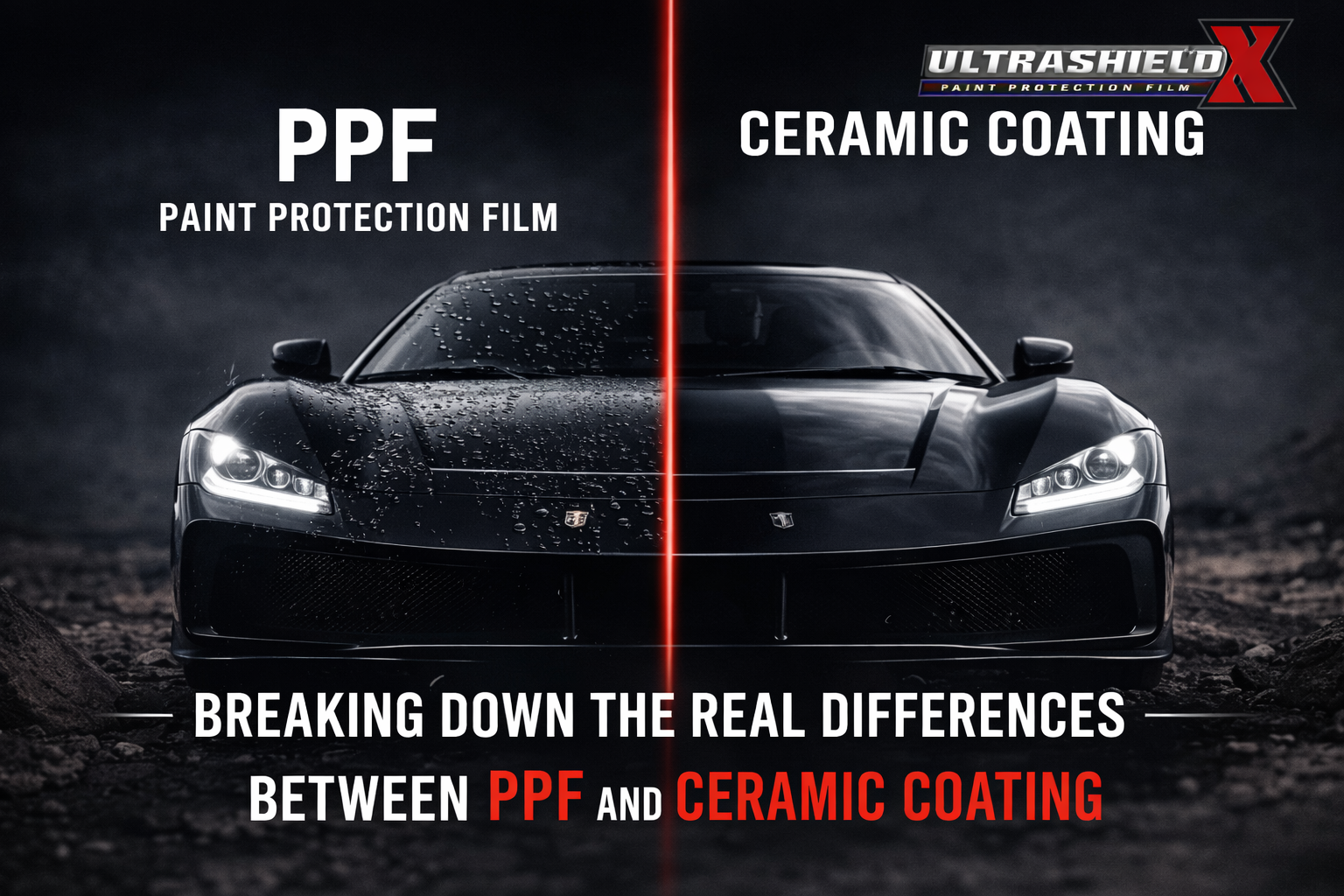
When you are seeking a way to retain the resale value and the beauty of your car, you must have come across two giants, PPF film for car and Ceramic Coating. But which is actually the superior of them?
We are UltrashieldX, who have been analyzing surface protection technology for years. We have deconstructed the science, the costs, and the performance in this complete blog to enable you to make an informed choice using the current industry standards.
What Makes Your Car Paint Fade So Fast?
Your car is under constant attack by the environment. Pigments are oxidized in areas where there is extensive heat and dust, resulting in a very dull appearance. Small stones knocked by the tire in the air cause road rash, and improper washing patterns result in unattractive swirl marks.
The latter damages are permanent and cannot be removed without a special layer of paint protection film on the car, thus necessitating costly repainting, which never appears to be exactly the same as factory-painted.
What Is Characteristic of the PPF film for Car, and How Does It Work?
Paint Protection Film (PPF), also known as a clear bra, is a high-grade thermoplastic polyurethane (TPU) membrane that is used to coat the painted areas of a car.
paint protection film for car is a physical coating, unlike liquid coatings. The most remarkable attribute that it possesses is its ability to heal itself. The uppermost layer of the film is an elastomeric polymer that, when subjected to heat (solar light or warm water), can literally melt down to its initial shape. This automatically removes scratches and swirl marks.
Extensive High Resistance to Stone Chips and Physical Abrasions
Longevity: Long-lasting films such as those of UltrashieldX can be used up to 5 to 10 years with proper maintenance.
What is Ceramic Coating and How Does It Differ?
Ceramic coating is a liquid polymer (mostly Silicon Dioxide or SiC) that chemically attaches itself to the factory paint on the vehicle. When it is cured, it forms a semi-permanent hydrophobic (water-repelling) surface that is much harder than the clear coat applied by the factory.
Although it does not come with the same impact protection as car paint protection film, it works very well at giving the car a deep and mirror-like gloss and makes the car very easy to clean. Dust, dirt, and mud slip off the surface in an ordinary wash.
Are You Willing to Provide Your Car with the Ultimate Shield?
Contact UltrashieldX Today to receive professional consultation regarding the most effective PPF for the protection of cars.
Comparison of Features of PPF VS. Ceramic Coating
In order to aid you in the visualization of the differences, we have provided a direct comparison of the two technologies.
| Feature | PPF (Paint Protection Film) | Ceramic Coating |
| Primary Material | Thermoplastic Polyurethane (TPU) | Liquid Polymer (SiO2 / SiC) |
| Physical Thickness | 6 to 10 mils (Thick) | < 1 micron (Thin layer) |
| Stone Chip Protection | High / Excellent | Minimal to None |
| Self-Healing Ability | Yes (With Heat) | No |
| Hydrophobic Properties | Moderate (Enhanced in top-tier) | Exceptional |
| Gloss Level | High (matte shades are also available) | Ultra-High / Mirror Finish |
| Chemical Resistance | High | High |
| Average Lifespan | 5 – 10 Years | 2 – 5 Years |
Which One Is the Best in Scratch Prevention?
Yes. Should the main worry for you be physical abuse, i.e., rock chips, key scratches, or door smacks, then PPF film for cars is the clear choice. The film is a transmissible material, and it is thick, so it takes the impact of a collision that would otherwise cut the paint.
What Protection Best Suits Your Life?
| If your priority is… | Choose PPF Film | Choose Ceramic Coating |
|---|---|---|
| Preventing stone chips from highway driving | Yes | No |
| Making the car easier to wash weekly | No | Yes |
| Guarding against minor parking lot door dings | Yes | No |
| Achieving a deep “wet look” shine | No | Yes |
| Long-term (7+ years) investment | Yes | No |
Is it Possible to Coat PPF and Ceramic Coating?
In fact, the most authoritative method of caring about the car (according to the EEAT model) implies that you are not to choose. In the detailing business, this is referred to as a “Complete Protection Plan.”
Most of the expensive detailers use Paint Protection Film on high-impact parts (hood, bumpers, mirrors) and then apply a Ceramic Coating to the entire car, including the film itself. This provides you with the ceramic technology of the “slickness” and the self-cleaning capabilities of the armor of the PPF coating on cars.
How Much is the Difference in the Cost of the Two?
In most cases, a good ppf film for car installation costs more than ceramic coating. This is because of the cost of the material of the TPU and the heavy work that goes into either hand-trimming or cutting the film to fit the exact panels of your car.
Nevertheless, while the cost of repainting a luxury car or the depreciation of a peppered front bumper may be significant, the optimal PPF coating for car helps in protecting your vehicle and is also repaid by preserving the original factory paint.
Conclusion
The decision to choose PPF film for car or Ceramic Coating for your car is not about which one to win; it is the one that best suits your driving lifestyle. Although ceramic coating styles offer exceptionally beautiful aesthetic benefits, nothing is more valuable than the physical protection of a high-quality paint protection film on a car.
At UltrashieldX, we deal with the best market competitor, which gives the best surface protection solutions that withstand time and climatic conditions. Do not allow the road to determine the appearance of your car.
Protect Your Drive Today!
Be prepared to have the best in automotive care? Our customers can choose the right package, whether they need the best PPF for car, an alternative to a high gloss ceramic finish, or they can get both services on their car.
FAQs on PPF and Ceramic Coating
Q1. Is Ceramic Coating Rock chip resistant?
A1. No. Although it makes the material hard and chemically resistant, it is too thin to resist physical strikes. PPF film for car is the only efficient way to provide real protection from stones and debris on the road.
Q2. Do I have the opportunity to overcoat my PPF film for car with Ceramic Coating?
A2. Yes. The use of a coating on top of your paint protection film is a pro-move. It gives unbelievable water-resistance and shine to the physical longevity of the film, and makes your car even easier to maintain.
Q3. Is Ceramic Coating more costly than PPF film for car?
A3. No. PPF film for car is more expensive to install because of the labor involved, which will be very precise, and because of the high cost of TPU material. Nevertheless, it has better value in the long term since it keeps paint chips and scratches away and prevents costly repairs.
Q4. Does the PPF film for car turn yellow with time?
A4. Yes, if the PPF film for car is not made of quality materials. UltrashieldX has high-quality TPU films with high UV inhibitors to avoid the yellowing process, and they stay clear and transparent for a couple of years, even under strong sunlight.
Q5. Does the Self-Healing aspect of the PPF film for car exist?
A5. Absolutely. The upper layer of quality car paint protection film is formed by elastomeric polymers. It is softened by heat (such as in the sun or warm water) and goes back to its initial form, leaving the light swirl marks no longer.
Q6. What one of you should be putting on your new automobile?
A6. Select PPF: Do you use highways and do not want to see rock chips and scratches?
Select Ceramic: wanted a mirror-like finish and a car that is easy to clean.
Go with both of the services: If you are not ready to compromise ultimate surface protection.
0 Comments